Elderly French Woman Outlives Family That Bought Her House
I f time makes fools of us all, you couldn't arraign André-François Raffray for taking information technology more personally than near. In 1965, Raffray, a lawyer in the southern French metropolis of Arles, thought he had hit on the existent-estate version of a sure thing. The 47-year-old had signed a contract to buy an apartment from one of his clients "en viager": a form of property auction past which the buyer makes a monthly payment until the seller's death, when the holding becomes theirs. His client, Jeanne Calment, was 90 and sprightly for her age; she liked to surprise people past leaping from her chair at the hairdresser. But even so, information technology couldn't exist long: Raffray just had to shell out ii,500 francs a month and expect it out.
He never got to live there. Raffray died in 1995, aged 77, by which time Calment was 120 and ane of the nearly famous women in France. She hadn't lived in the rooms she endemic above the Maison Calment, the drapery shop once run by her husband in the center of Arles, for a decade. Instead, as each birthday thrust her further into the realm of the improbable, Calment held court at La Maison du Lac, the retirement home next to the city hospital. She had no firsthand family – her married man, daughter and grandson were long dead – but journalists and local notables would regularly visit for an audience. "I waited 110 years to exist famous. I mean to make the almost of information technology," she was reported to have said. 1 party slice was recounting how, as a teenager, she had met Vincent van Gogh; he was ugly and dishevelled, she said, and locals called him "the dingo".
The pensioner appeared blessed with the stamina of Methuselah. Even so cycling at 100, she only gave upwards smoking at 117; her doctors ended that she had a mental chapters equivalent to about octogenarians. Plenty, at any rate, to coin the odd zinger: "I await for death… and journalists," she once told a reporter. Aged 121, she recorded a rap CD, Mistress of Fourth dimension. But fifty-fifty this "Michael Hashemite kingdom of jordan of ageing", as one geriatrician put information technology, had only so much route to run. By 1996, she was in steep decline. Using a wheelchair, largely blind and deaf, she finally succumbed on 4 August 1997. At 122, hers was the oldest validated human lifespan in history.

Some, though, believe information technology'due south not simply time that makes fools of usa all. Terminal year, a Russian mathematician called Nikolay Zak fabricated an astonishing claim: that it was not Jeanne Calment who died in 1997, but her daughter, Yvonne. Sceptical about the degree to which Calment had surpassed previous tape-holders (the nearest verified claim at the fourth dimension was 117), Zak had dug into her biography and uncovered a host of inconsistencies. First published on Researchgate, a scientific social networking site, and so picked upwards by bloggers and the Associated Press news agency, Zak's paper claimed that Jeanne Calment had actually died in 1934; co-ordinate to official records, this was when Yvonne had lost her life, aged 36, to pleurisy. At this point, Zak alleged, her daughter had causeless her identity – they looked similar – and she kept up the pretence for more than 60 years.
When the paper went viral, the French press exploded. How dare someone slur a national treasure, the adult female dubbed "la doyenne de l'humanité"? And who was this upstart Russian anyway? Zak wasn't even a gerontologist, a specialist in ageing, just a 36-twelvemonth-old mathematics graduate who worked as a glassblower at Moscow State University and hadn't published a paper in 10 years.
Zak doubled down in response. He published an expanded newspaper in the U.s.a.-based journal Rejuvenation Research, in January this year. It compiled a dossier of 17 pieces of biographical bear witness supporting the "switch" theory, including inexplicable physical differences between the young and old Jeanne (a alter in eye color from "night" to greenish) and discrepancies in the verbal testimonies she gave while in the retirement home: she claimed to accept met Van Gogh in her father'due south shop, when Jeanne's father had been a shipbuilder. He also claimed there had been no public celebration of Jeanne's 100th birthday, a primal reference point in old-age validations.
Every bit Zak admitted, at that place was no smoking gun; but together these pieces of circumstantial bear witness did emit a fair amount of smoke. Crucially, he suggested a plausible motive: that Yvonne had taken her mother'southward place in order to avoid punitive inheritance taxes, which during the interwar period ran as high equally 35%.
The argue spread through the French press and international gerontological circles, becoming increasingly heated. Many dismissed Zak'southward switch theory as Russian-sponsored "false news", as the newspaper Le Parisien put it. Certainly, it seemed to be an attack on western science. As well as Calment, Zak expressed doubts nearly the validation of Sarah Knauss, a Pennsylvanian insurance function managing director who had died in 1999, aged 119, putting her in the silvery-medal position behind Calment. Was the Russian trying to sow doubt, so that his countrymen could accept the atomic number 82 in the gerontology field?
For the people of Arles, it was a matter of local pride. They rapidly rallied backside Calment and formed a Facebook grouping, the Counter-Investigation into the Jeanne Calment Investigation, to dismantle Zak's claims. Their members included Calment's distant relatives, and others who had known her; although some said she had been haughty and waspish, they didn't want her reputation sullied. They had easy access to the city's archives, while Zak had never been to Arles: what could he know? He shot back, on their open counter-investigation forum: perhaps the "Arlésiens" were but blinded by their allegiances. "Annotation that from a distance it is obvious that the Earth is not apartment," he wrote.
Both camps were equally adamant. One, that the woman who died in the Maison du Lac was the longest-lived human being. The other, that she was a gifted and almost inconceivably determined con artist. Which was the real Madame Calment?
A n age of 122 seems to defy the limits of the possible. Even ii decades afterward, with boilerplate lifespans all the same ascent, no one has come within touching distance of Jeanne Calment. In the supercentenarian league – 110 and above – the three-year gap between her and Knauss might every bit well be an aeon.
In 1825, the British actuary Benjamin Gompertz came up with a prediction model for human mortality, one which estimated that the risk of death increased exponentially with age, doubling every 8 years. His "Gompertz bend" was chop-chop taken up by the insurance industry. In the year after a 100th birthday, the chance of death is roughly 50%. Knowing this, Calment'southward record looks even more than of a statistical long shot.
In Arles'southward Trinquetaille cemetery, there is lilliputian to marker out the person with the world'southward longest lucky streak, apart from the small-scale book-shaped plinth engraved " La doyenne de l'humanité" on her tomb. When I visit in the last days of August, summer has checked out early; the sky is overcast, the first fall leaves are on the ground. On the mottled, dark-grey marble of Calment'south family tomb stands a pot of imitation chrysanthemums and a yellowing succulent. Curiously, Joseph Billot, Jeanne'southward son-in-police and Yvonne's husband, and her grandson Frédéric Billot are marked, merely her daughter is non. Even so the cemetery guardian, in a hut a few metres away, assures me that Yvonne is buried with her female parent.
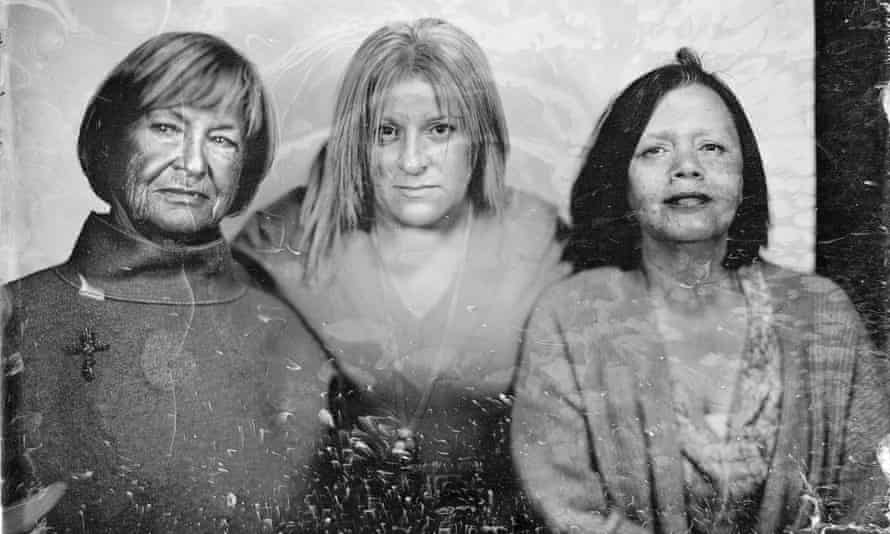
In a hotel garden next to Arles'south Roman amphitheatre, I meet three members of the counter-investigation Facebook group: Colette Barbé, Cécile Pellegrini and Brigitte Jajcaj. I mention that it seems odd that Jeanne did not put her own daughter's name on the family tomb; was it Yvonne who decided not to, trying to tell the states she was still alive? "Oh, so you followed her all the mode to the cemetery, and so?" jokes Barbé. Don't overthink it, the women say. The grave wasn't renovated until the 1960s, presently later Calment'due south son-in-law and grandson died (the latter in a automobile crash); past and then, Yvonne had been dead for xxx years, and Jeanne but had the most recent deaths engraved.
They are an incongruous trio of detectives: Pellegrini, the group administrator, is a quick, ironic speaker whose one-half-Vietnamese grandfather opened the city's first Asian eatery; Jajcaj has swept-back grey hair, a rose shoulder tattoo and a black-tasselled padlock on a chain effectually her neck; Barbé is a strong-minded bourgeoise, vibrantly attired and draped in jewellery. The counter-investigation has 1,500 members, fatigued from all over the globe, although the core grouping is made upwards of proud locals. "[Calment] was this elegant lady, even with a cane – an emblem of Arles," says Jajcaj. "She held herself perfectly upright at 102, which was beautiful."
Soon after Zak'south paper was published, the group began to scour local archives for evidence that undermined his theory. Distant members of the Calment and Billot families opened upward their photo albums and personal papers. In the spirit of open argue, Zak was besides accepted on to the forum, where he kept upwards a running commentary on the new findings. He was collegiate on the surface, acknowledging that he and the counter-investigation had a shared goal: the truth. But over fourth dimension they felt his attitude – demanding people chase after testify on his behalf, unfailingly using information technology to back up his ain theory – begin to rankle. "Sometimes I get the impression that he thinks he understands our fashion of life and history ameliorate than united states of america," says Barbé.
But digging into the past began to pay dividends. 1 new photograph donated by a family fellow member showed Yvonne posing on a balustrade with a parasol against a mountain backdrop. Clever sleuthing with postcards and Google Maps revealed information technology to be office of the Belvédère sanatorium in Leysin, Switzerland – consistent with Yvonne'south diagnosis of pleurisy, frequently a symptom of tuberculosis. Some other certificate seemed to confirm the gravity of her status: her husband, Joseph, an regular army colonel, was granted five years of empathetic leave in June 1928 to look subsequently her. Unfortunately, the sanatorium closed in 1960, and its records haven't survived.
If the switch did take place, maintaining this fiction in plain sight would take required an boggling and queasy level of deception. Yvonne would take had to share a house with Jeanne's widower, Fernand, her own male parent, until his death in 1942; Fernand would have had to pass his daughter off as his wife. Yvonne would take had to force her son Frédéric, seven when "Jeanne" died, to stop calling her "Maman".
Many others would need to have been complicit. If Zak knew either the people of Arles or Jeanne Calment, the group argued, he would realise how improbable this was. A conspiracy would take been hard to maintain in a close-knit population of twenty,000, and unlikely given Mme Calment's reputation as a "dragon", says Pellegrini. "If people had known about the fraud, they wouldn't accept protected her," she says.
Perhaps the well-nigh of import blow from the counter-investigation group – not quite a mortal one, but close – was attacking Zak's idea of a financial motive. The Russian had claimed Yvonne was trying to escape a 35% inheritance revenue enhancement, but the group'southward research led them to believe it would take been more than similar half dozen-vii% – a rate the family could have managed, with Fernand Calment'southward considerable assets.
But Zak refused to budge. Only a DNA exam, either from Trinquetaille cemetery or a sample of Calment's claret, rumoured to exist stored in a Paris research establish, would settle the affair, he argued. Just the women from the counter-investigation grouping believe he has gone too far downwardly the rabbit hole to consider any theory merely his own. "Even if [a Dna test] proves information technology was Jeanne, he'll never accept information technology," says Pellegrini. "He'll say the tests were rigged."
T here is some debate about what happens to rates of bloodshed in extreme old historic period. Some researchers believe they go along to rise with the Gompertz curve, until the risk of death in a given twelvemonth is absolute – with an constructive ceiling to homo life somewhere betwixt 119 and 129. Others believe there is no such ceiling, thanks to a miracle known as "bloodshed deceleration": the plateauing of the death charge per unit after 105. Simply at that place are doubts about this plateau, besides, due to the frequent misreporting of supercentenarians (generally due to clerical fault, rather than fraud). With such a pocket-sized dataset fifty-fifty a few errors can skew our agreement of human limits (the Gerontology Research Grouping, based in Los Angeles, estimates that in that location are virtually i,000 living supercentenarians).
The validation of Jeanne Calment's age, though, is regarded as the "gold standard" by Jean-Marie Robine, the human being who helped carry it out. I meet him at his home in the village of Pignan, just west of Montpellier. Long legs stretched out in aquamarine lath shorts nether his kitchen table, the researcher still has matinee-idol looks at 68. His work with Calment, carried out as a demographer for the French state arrangement Inserm (50'Institut National de la Santé et de la Recherche Médicale), "never had validating her age as a mandate," he explains. "It was to validate the quality of the administrative documents that attested to her age. And from what we had at our disposal, there was nothing dubious." He points at the unbroken chain of thirty censuses – every five years up until 1946, so every seven to 8 – that relate Jeanne Calment'south life in Arles.
Merely ane – the 1931 census – was puzzling. Yvonne is not listed as resident in the family's Arles apartment, which Zak takes to mean that she was already living semi-secluded in the family'due south state house, 10 miles away in the village of Paradou. He argues that she would masquerade as her mother, in order that Jeanne, the one who was actually suffering from tuberculosis, could avoid the disease's social stigma. Robine has a simpler caption: that Yvonne was at the sanatorium at Leysin.
He is scathing near the Russian theory, flatly dismissing information technology equally "pseudo-science". But he and his co-validator, Michel Allard, have been criticised by Zak, and past some on the counter-investigation forum, for non beingness more thorough in their own corroborations. They did, however, conduct a serial of nearly 40 interviews with Calment at the Maison du Lac, asking for details of her life that only she would know. She made some slips, unsurprisingly for her historic period, often mixing upwardly her father and married man. (Zak jumped on such mistakes in excerpts of the transcripts later published in a volume.) Merely many other details, such as the names of maids and teachers, largely tallied with the data recorded in censuses and school registers.
Robine is softly spoken, but it is hard to get a word in edgeways as he builds his argument. I mention the idea that a DNA test on Calment's blood could settle the fence. Jeanne's husband Fernand was her distant cousin, so Yvonne had more ancestors mutual to both sides of her family than her mother – something that would be visible in her DNA. Robine tin barely hold back his indignation at the suggestion of Deoxyribonucleic acid testing. "What are nosotros going to do – just hand it over to the Russians? To an international committee? To do what? These people are caught upward in magical thinking – that the hugger-mugger of longevity is in her genes."
B y Baronial 2019, l'affaire Calment had settled into a stalemate. When I speak to Zak over Skype at his dacha on the Ukrainian border, he seems more than determined than e'er: "With so much opposition, I want to prove that I am right," he says. At that place is a wink of intellectual pride behind his poker-face. Boyish in a blue polo shirt with tousled hair, a slight grin occasionally breaks his composure. "Some people don't care about facts. And so they just hate those who disagree with them," he shrugs.
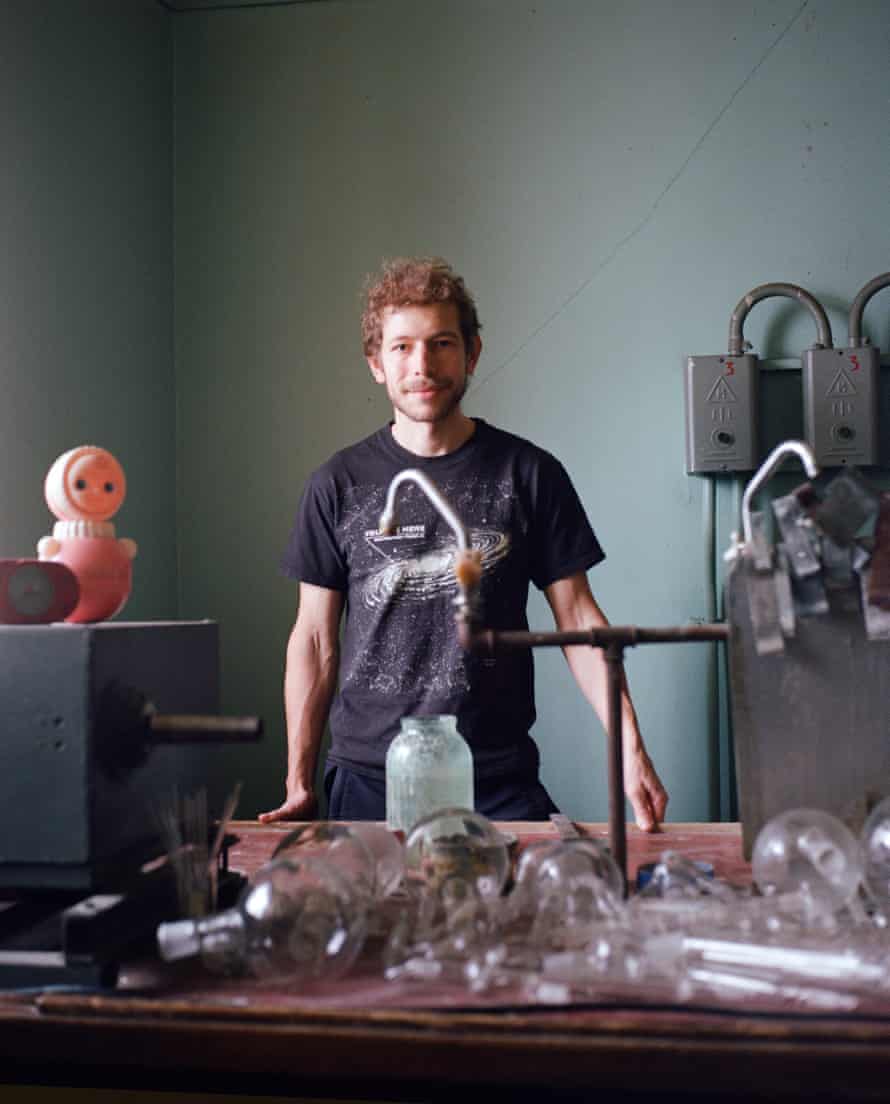
Gerontology had originally been a hobby for Zak. He was interested in the ageing procedure of the naked mole-rat, an animal with an improbably long lifespan of well-nigh 30 years. But he became caught upward in the Calment case after making contact on Facebook with Valery Novoselov, head of gerontology at the Moscow Lodge of Naturalists (MOIP), who had longstanding suspicions about her. Novoselov'due south case had been based largely on photographic analysis; he encouraged Zak, who spoke some French, to delve into other aspects, such every bit biographical and archival evidence. Zak says he had no intention of publishing anything – until he contacted Jean-Marie Robine about the "issues" he had found. "He always had some excuse about why he couldn't reply, which I idea was foreign," says Zak. "Information technology was this that made me carry on." (Robine disputes that he was evasive, saying he corresponded extensively with Zak in Oct 2018.)
Meanwhile, others were get-go to accept doubts about Zak and Novoselov. Robert Young, who validates supercentenarians for Guinness World Records, believes the attack on Jeanne Calment is a deliberate attempt to sow doubt nearly western scientific methods, amounting to "academic fraud". He points to what he sees every bit Zak'south obstinate refusal to consider any scenario other than the switch theory. "Part of the scientific testing method is that we demand to exist open to multiple possibilities, including that one'due south own position may be wrong," Immature says. "Yet he self-declares his position to be 99.ix% certain." Zak counters that he has fully analysed the opposite scenario – that Jeanne was Jeanne – in follow-up piece of work this year, and rejects accusations of fraud.
Besides as the lack of academic rigour in the original paper, Young believes its disproportionately high number of reads (70,000, when the revised version but got 1,400) might have been inflated by bots, or human intervention. Zak also manipulated a photograph of a young Yvonne Calment to emphasise what he believed (others dispute it is visible at all) to be a growth on her nose after possessed by her mother. Young alleges that such sleights of mitt indicate that Zak, or people working with him, had an ulterior agenda.
All the same, the switch camp had arguments that couldn't hands be dismissed. At that place was Calment'south odd request, when Arles's archives asked for them, that her personal papers be burned; and a 2006 account in a French manufacture paper of a dinner at which a invitee intimated that Calment'due south insurers had known of the identity switch, but no activeness had been taken considering she was already too famous. In mid-September, Inserm released an official rebuttal newspaper, co-authored past Robine, Allard and two others. While it didn't address every aspect of the Russian example, it was a cool riposte, summarising many of the counter-investigation'due south discoveries, and calling for the formal retraction of Zak'south paper.
Zak upped the ante. In an open letter of the alphabet sent to prominent gerontologists, longevity researchers and journalists – with Vladimir Putin, Emmanuel Macron, Boris Johnson and the White House CCed – he called once again for the testing of Calment's Deoxyribonucleic acid. "I don't think such a report would exist harmful to anybody," he argued, "while the potential benefits for scientific discipline are huge." Many people thought Zak had gone too far. One fellow member of the board of Rejuvenation Research, which had published his revised paper, resigned, saying it had "disgraced the field of gerontology in both Russian federation and internationally".
Back in Arles, the counter-investigation group were also wondering about the peculiar behaviour of their "Russian friend". He had been helpful at first, but in the depths of long comment threads he could often be provocative, even goading. Ane fellow member succeeded in getting Zak temporarily blocked from the forum on 5 March for a slanging match that culminated in the Russian calling him a "crook". "Information technology's very unpredictable," says Cécile Pellegrini. "Sometimes he has a humour, other times he's odious, and we're forced to block him for a few days." They speculate that more than 1 person might be using his business relationship, and that Zak or the Zaks might be paid trolls. (Zak denies receiving whatever payment or support from others.) But if Zak is a frontman, who might he be fronting for?
T he theory that the Calment assail has been politically directed is dismissed by Novoselov, the gerontologist who tasked Zak with investigating her. "Expect, no one in Russia cares at all nigh this story," he says. "They couldn't intendance less. There have been two articles in the media, and that's it." Novoselov says he is simply following his scientific instincts, and compares the French attachment to Calment to the national cult of Joan of Arc. "Their ability to believe in such fairytales is ane of the primal reasons behind the creation of this [longevity] record."
The straight-talking 57-year-old is speaking in the canteen at the Research Center for Obstetrics, Gynecology and Perinatology in Moscow, where he has simply given a lecture on Calment. Having previously argued that Lenin died of syphilis rather than a stroke, Novoselov is used to courting controversy. In January, he alleged that his goal was to get Calment struck off the supercentenarians annals. Wasn't it cavalier to practice so before at that place was conclusive evidence? "What's conclusive bear witness if at that place is no cloth from the patient?" he counters. "If they showed u.s.a. her medical records, then maybe nosotros would exist convinced."
Novoselov wrote to Immature about Calment in October 2018, "asking him to look attentively at the problems we raised". The American took it, says Novoselov, as "a brandish of aggression by Russia confronting everything civilised"; afterward a cordial initial response by email, Young later characterised his work as a conspiracy directed from on high by "someone of import". Only it's not surprising that Novoselov'due south abrasive tactics have raised eyebrows; he has threatened Young, as well as Calment's validators, with investigation past Sledkom, the Russian FBI.
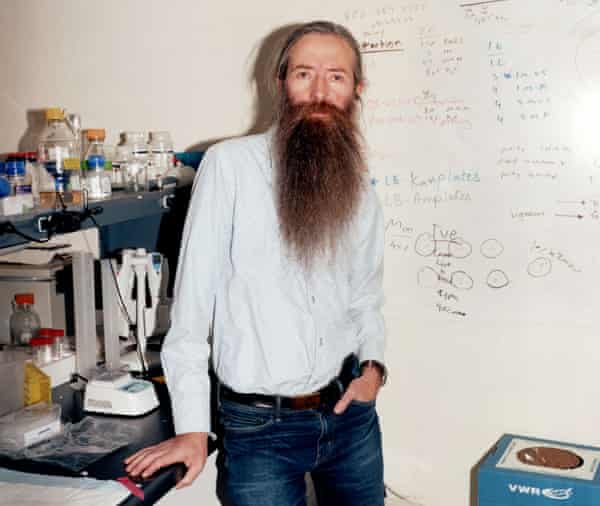
The evidence for a Russian disinformation campaign is thin, but Zak's newspaper did have a second sponsor. The peer-reviewed version was published in Rejuvenation Enquiry, the journal devoted to life-extension research edited past Aubrey de Grey, the controversial gerontologist and life-extension abet who has claimed that, by 2100, the man lifespan could accomplish v,000 years. Even if Zak doesn't believe it, the possibility that Calment did accomplish 122 is tantalising for De Grey. "Anyone who is the world record holder of longevity is of interest to those of us studying the biology of ageing," he tells me.
Speaking on the phone from London, where he is on a stopover betwixt Berlin and his home in California, De Grayness is evasive about whether his strategy is to forcefulness the release of Calment's claret sample. But he does call back it should be made available for science: "In the interests of saving lives, finding out more about ageing to eventually postpone ageing – then that's actually quite important." Would he desire his own research foundation, Sens, to do the Dna testing? Not necessarily, he says, "but I would certainly know the right kind of researchers to recommend".
That analysis seems unlikely to happen any time before long. The Fondation Jean Dausset, a private genetic research heart in Paris, refuses even to confirm that it is keeping Jeanne Calment's blood; just that information technology has a collection of biosamples it lonely can utilise for research nether anonymised conditions. Just François Schächter, the scientist who in the 1990s founded its Chronos Project, the starting time genetic survey of centenarians in the earth, has confirmed that her blood was taken and her Dna extracted.
Twenty years ago, the life-extension field promoted past mavericks like De Grey was outlaw science. Now, the landscape has changed: the technical means for "hacking" the man lifespan have come into being, and the sector is commencement to concenter serious investment. In 2013, Google invested $1.5bn in an entire division, Calico, devoted to "solving expiry". PayPal co-founder Peter Thiel has given millions of dollars to Sens.
But Sens, according to its annual reports, has been running at heavy losses. De Grayness says it has been spending the $13m he put into the foundation in 2011 on research for anti-ageing therapies that will salve "several million" lives. Merely it must starting time to pay its way; wouldn't securing the DNA of the oldest woman in the world be a slap-up publicity coup, every bit death-dodging tech billionaires pile into the sector? De Grey bats off this idea. "I get enough media attending as information technology is."
If he could study Calment'due south DNA, what might he expect to learn? De Grey points out that supercentenarians' genetic material contains a high ratio of useful data, "because they have to get more things correct in club to become to the age they do". One obvious area of interest is how Calment bypassed cancer, center disease, diabetes and other belatedly-life killers.
Several scientists I spoke to believe that Calment's genome should be made available for study; but they don't approve of the way Zak and De Grey have seemingly attempted to strength the foundation's manus. One consequence of promoting the switch theory, they bespeak out, is that they take alienated family members whose ain Dna might be crucial in understanding Calment's.
Before this month, a Russian news agency announced that a woman who was purportedly 123 had died in the Astrakhan region of southern Russia. This is near certainly impossible – even Novoselov thinks and so; given her children's ages, she would have given birth three times in her 50s. But the story underlines the need for gerontology to continue its house in gild.
At the time of going to press, scientists from around the world were due to discuss the impact of the Calment affair on gerontology at a special meeting in Paris. Equally for her mortal remains, some think the Fondation Jean Dausset might exist more open to collaboration as anti-ageing scientific discipline evolves – only it is unlikely to be with De Grayness. Despite telling me that Jeanne Calment does non effigy loftier on his priorities, he plans to devote another effect of Rejuvenation Research to age validation and Calment side by side year.
In Arles, despite everything, the counter-investigation group are amused past the thought that Jeanne Calment might have been a master fraudster. "I would really like the switch story to be true, like in the novels I love reading," says Cécile Pellegrini. "I find that kind of thing super-exciting. If it'southward actually truthful, she was really something!" But perhaps the doyenne has something else to teach the would-be immortals of Silicon Valley: what extra trouble would five,000 years of existence bring, if we can't get the record straight on a unmarried ordinary lifetime?
Boosted reporting by Marc Bennetts
This article was amended on two December 2019 to right the spelling of Cécile Pellegrini's surname in a photo caption; on three December to clarify the interactions between Novoselov and Young; and on ten Dec to farther clarify Novoselov and Young'southward substitution and the circumstances of Nikolay Zak's photograph-editing.
williamsgrayoucand.blogspot.com
Source: https://www.theguardian.com/science/2019/nov/30/oldest-woman-in-the-world-magical-thinking

Post a Comment for "Elderly French Woman Outlives Family That Bought Her House"