Why Did They Make Alcohol Legal Again
T he US libertarian thinktank the Cato Institute – which incidentally offers the first answer you get to this question if you do enquire Google – doesn't mince its words nearly the failure of prohibition. "National prohibition of alcohol (1920-33) – the 'noble experiment' – was undertaken to reduce crime and corruption, solve social problems, reduce the tax burden created by prisons and poorhouses, and improve health and hygiene in America. The results of that experiment clearly indicate that information technology was a miserable failure on all counts." For the Cato Institute, every bit far as prohibition is concerned, there are no half measures.
Information technology also seeks to draw social and political lessons from this era: "The testify affirms sound economic theory, which predicts that prohibition of mutually beneficial exchanges is doomed to failure. The lessons of prohibition remain important today. They utilize not only to the contend over the war on drugs but also to the mounting efforts to drastically reduce access to alcohol and tobacco and to such bug every bit censorship and bans on insider trading, abortion and gambling." Marketplace manipulation for social ends is a recipe for disaster – or so the libertarians would have united states believe.
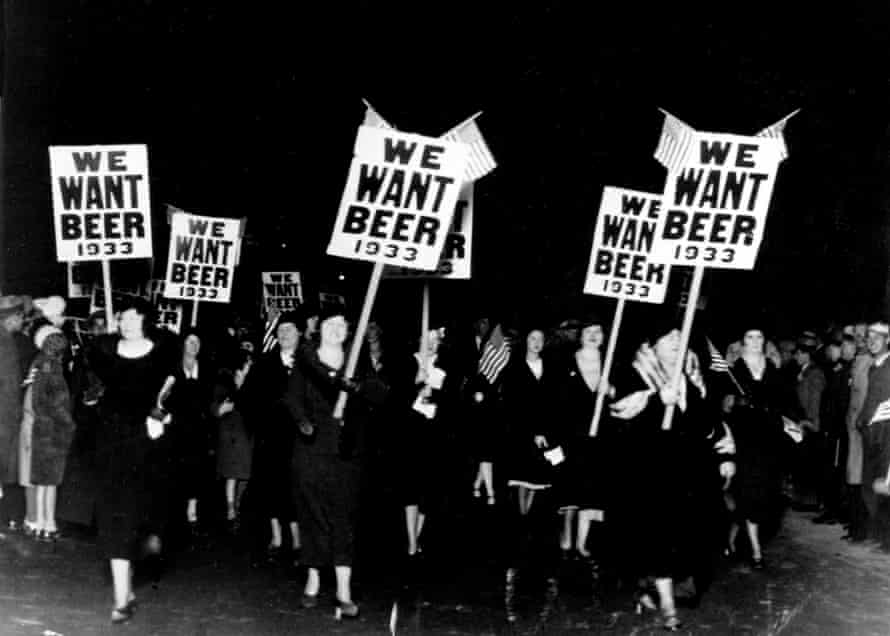
The plant is of class right to say that prohibition failed. The 18th amendment to the US constitution passed in 1919 – which paved the manner for the ban, a year afterwards, on "the industry, sale or transportation of intoxicating liquors within, the importation thereof into, or the exportation thereof from the United States" – was repealed in 1933 past the 21st amendment, in effect cancelling out the 18th: the only constitutional amendment in US history always rescinded. This was both success – in getting the constitution amended in the first identify – and ultimate failure on a colossal scale.
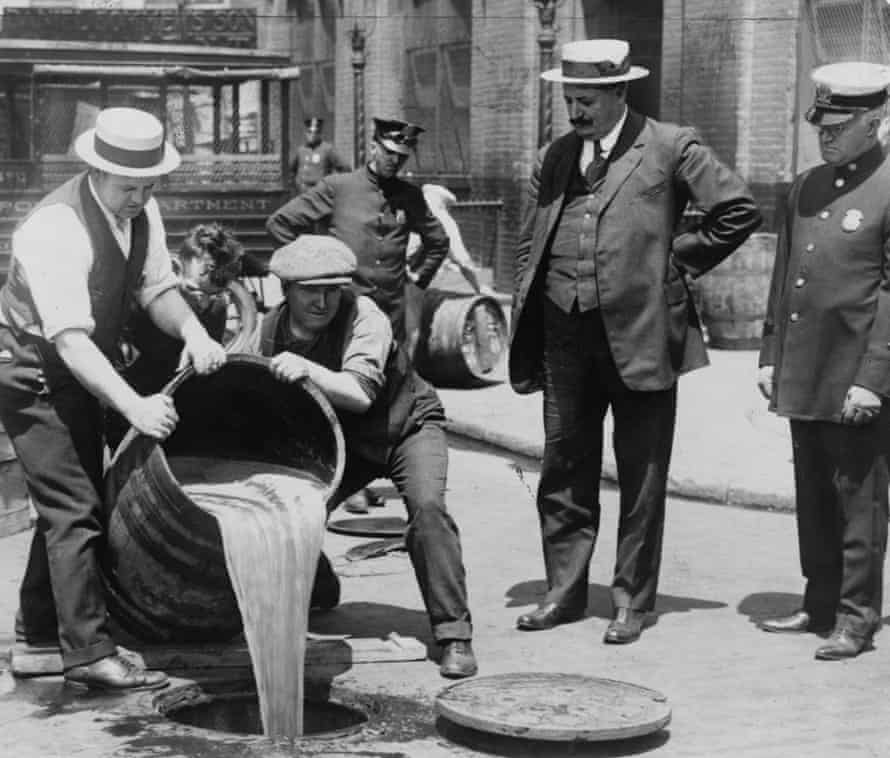
Notwithstanding, those who debate that prohibition was doomed from the outset – the victim of some immutable economical law – autumn into the classic historical trap of using hindsight to judge a historical phenomenon. This understates the power of the temperance movement in the US, edifice on a century of campaigning confronting drink and its antisocial furnishings; the strength of feeling in individual states, some of which had already declared themselves "dry" before prohibition was introduced nationally in 1920; and the standing support for prohibition in the 1920s.
Every bit the temperance historian Jack Blocker has pointed out, in the 1928 presidential contest the "dry out" candidate, Herbert Hoover, was able to run into off his "wet" rival Al Smith – this at the height of the so-called jazz age, with its reputation for out-and-out hedonism. Prohibition was non quite as doomed – or as lunatic – equally some critics like to propose. It needs to exist understood historically, not only dismissed as an aberration.
The central to agreement the strength of the temperance move in the US at the turn of the 20th century was the sheer awfulness of saloons. It was no coincidence that the organisation that coordinated the assault on alcohol was chosen the Anti-Saloon League. Saloons were synonymous with drunkenness, gambling, prostitution, drugs and political corruption – politicians used them as places to in effect buy votes by offering jobs and other inducements. It was not so much drink that campaigners wanted to eliminate as these dens of iniquity.
Loathing of saloon culture was part of a generalised fear of social disintegration: the Us was rapidly industrialising and urbanising; immigration was creating ghettoes in US cities, which were seen as potentially incendiary; labour militancy was increasing, as were African-American protests; socialist and anarchist agitation fanned the flames of urban discontent – and made rural, Protestant America fear for its country and its moral values.
The battle over prohibition was in many respects a fight between two Americas – onetime and new, rural and urban, Protestant and Cosmic, rich and poor, established and immigrant – and in the stop the emerging, urban ethos encapsulated in President Roosevelt's New Deal won. Prohibition was a staging post on the road to a new America, just quondam America did not give upwards without a struggle.

The strength of anti-saloon feeling – you practise not go an amendment to the US constitution passed on a whim – gave prohibition a fighting run a risk of succeeding. Even after repeal in 1933, some states chose to remain dry out, and the last to yield, Mississippi, only did so in 1966. Only in that location was a fatal flaw at the heart of the Volstead Act, which put the provisions of the 18th amendment into practice. It banned the manufacture, sale and distribution of booze for drinking purposes (industrial alcohol was exempted), only it did not outlaw consumption. People could yet potable – if they could get agree of the stuff.
And get hold of it they did – from the criminal bootleggers who multiplied and became rich on the proceeds of smuggling, from the individuals making "moonshine" (which sometimes proved fatal when drunk) in their bathtubs, and in the "speakeasies" that proliferated across urban America. Presidents drank, senators drank, congressmen drank, police chiefs drank. Turning a bullheaded eye to criminals such equally Al Capone allowed fortunes to be built on bootlegging.
If you wanted a beverage, you lot could get i – indeed the joke was that it was easier to get booze under prohibition than previously, when a patchwork of regulations had limited where and when you could buy alcohol. Some experts have argued that the federal appliance of enforcement was never sufficient to law such a far-reaching slice of legislation over a country every bit vast every bit the US.
But historian Lisa McGirr, in her recently published volume The War on Alcohol, says it was not the efficiency of enforcement that was at mistake. Where the authorities wanted to act, they were effective, and proved a more intrusive presence in many Americans' lives than ever earlier. Just, she argues, enforcement had an in-built class bias: the state of war was waged primarily against the poor, the working class, immigrant communities, the marginalised.
That attack was most systematic in the mid-west and the due south, where the Ku Klux Klan were active in pursuing bootleggers and backsliders. Just as the Volstead Act represented a rearguard action by old, militant Protestant, white America, so its enforcement was conditioned past the values and social biases of the groups that had backed information technology. Complete prohibition was always going to exist desperately difficult to enforce, but this patchy, politically motivated, socially divisive application of the human action made information technology increasingly unpopular.
An unenforceable or corruptly enforced law is a bad constabulary, and the Volstead Deed was eventually discredited. Information technology decimated the legitimate beer, spirits and fledgling vino industry in the United states of america, but Americans who wanted to drinkable carried on drinking as alcohol flowed in from neighbouring countries. Estimated consumption in the 1920s dropped to half its previous level – a long way curt of the teetotalism that temperance campaigners, who believed that alcohol consumption would somehow become a historical anomaly, believed was possible.
Besides every bit boosting organised criminal offence and political corruption, prohibition made life worse for many hardened drinkers. The trend away from spirits towards beer was reversed during prohibition, because bootleggers fabricated greater profits past smuggling spirits. And there was less remedial help available for alcoholics because heavy drinking was seen as a moral declining rather than a affliction. Alcoholics Anonymous was not formed until 1935, ii years afterward repeal, by which time information technology was possible to split social drinking from habitual drinking, drinking for leisure from drinking for life.
Prohibition ultimately failed because at least one-half the adult population wanted to carry on drinking, policing of the Volstead Human action was riddled with contradictions, biases and abuse, and the lack of a specific ban on consumption hopelessly muddied the legal waters. In truth, while there was a desire to curb the anti-social furnishings and moral deposition of drinking, and to strike against the forces perceived as threatening the social and political status quo, there was no national will to stop the act of drinking itself.
The law staggered on for 13 years – testament to the forcefulness of the forces of old America – only growing disillusionment and the coming of the Great Depression, which meant the government urgently needed the return of liquor taxes, ensured its demise. It is now seen equally something of a footnote in US history – a bizarre episode betwixt the start world war and the Depression – but because it encapsulates a disharmonism betwixt ii visions of America, it deserves to exist far more than that.
Moreover, despite the failure of prohibition, it did change American guild – and the country's drinking habits – for ever. The one-time-fashion saloons disappeared; drinking at home became much more frequent; drinking among women, who had previously establish saloon civilisation uncongenial, indeed hostile, became more common; drinking became regularised, normalised, and eventually an accepted part of "polite" club – by the 1950s cocktails were seen as the height of civilisation in many centre-class homes.
Drunkenness had non been eliminated, but somehow society had come to accept drunks. The entertainer Dean Martin even managed to build a career on pretending to be addicted to the bottle. He was so convincing that some viewers thought he was. Far from changing nothing, the era of prohibition changed everything. Consumption levels did eventually return to pre-1920 levels, but drink was never seen – or consumed – in quite the aforementioned manner again.
williamsgrayoucand.blogspot.com
Source: https://www.theguardian.com/commentisfree/2016/mar/30/prohibition-google-autocomplete

Post a Comment for "Why Did They Make Alcohol Legal Again"